
Forklift Solid Tires are durable industrial tires designed for forklifts used in warehouses, factories, logistics centers, ports, workshops, and heavy-duty material handling operations. They do not depend on air pressure, so they can resist punctures, support stable load movement, and reduce downtime in places where forklifts move pallets, containers, raw materials, molds, tools, and finished products every day. For buyers who manage warehouse equipment, choosing forklift solid tires is not only a tire replacement task; it is a decision that affects safety, maintenance cost, floor condition, and daily handling efficiency.
Many purchasing mistakes happen because buyers only check the tire size and compare prices. A forklift tire may look simple, but it works under repeated pressure, sharp turning, braking, loading, and long operating hours. If the tire is too soft, too hard, poorly matched to the floor, or not suitable for the forklift load, the warehouse may face faster tire wear, operator complaints, floor damage, or unexpected replacement. A better evaluation starts with the way the forklift is actually used.
Start with the Route, Not the Catalog
A useful way to evaluate forklift solid tires is to walk the forklift route before ordering. The route tells the buyer more than a product catalog can. A forklift that moves between a loading dock and a storage rack has different tire needs from a forklift working near metal scraps, outdoor yards, or production lines.
Buyers should look at floor texture, turning space, loading areas, travel distance, and obstacles. Smooth warehouse floors usually require tires with stable rolling, low vibration, and good wear performance. Rough floors may require stronger rubber structure and better impact resistance. If the forklift crosses dock plates, thresholds, or outdoor sections, the tire must handle mixed conditions.
Load Cycles Change Tire Performance
Forklift solid tires must carry the machine, the operator, the attachment, and the goods. However, the real challenge is not only the maximum load. It is the number of load cycles in one working day. A forklift that carries medium loads for ten hours can create more tire stress than a machine that carries a heavy load only occasionally.
Before selecting forklift solid tires, buyers should check the average load, peak load, operating hours, turning frequency, and whether the forklift often brakes under load. Tires used in high-frequency operations need stable compression resistance and a compound that can withstand repeated heat and friction. This is especially important in logistics centers, manufacturing plants, and busy warehouses.
Tire Size and Rim Fit Must Be Exact
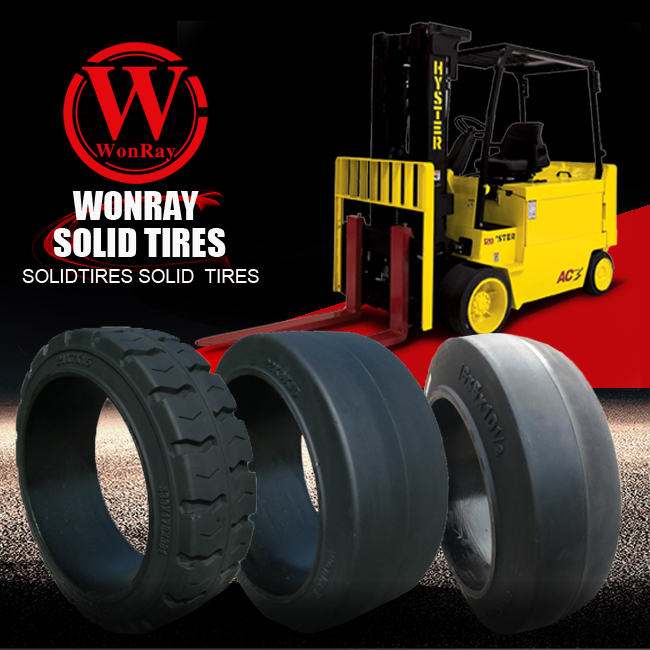
Forklift solid tires should match the original tire size and rim specification. A small mismatch can affect installation, stability, and forklift handling. Buyers should confirm the tire size printed on the current tire, the rim type, the forklift model, and the working position of the tire. Front tires and rear tires may experience different stress because the drive axle, steering axle, and load distribution are not the same.
Accurate fit helps reduce abnormal wear and supports safer operation. When buyers are unsure, they should collect tire markings, photos of the rim, forklift model information, and actual working conditions before confirming the order.
Choose Tread According to Floor Conditions
Tread design affects traction, wear, vibration, and floor contact. Forklift solid tires used on clean indoor concrete usually need smooth and stable contact. Tires used on rougher ground or slightly wet surfaces may need more grip. Deep tread may improve traction in some conditions, but it can also increase vibration on smooth floors. A smooth or moderate tread may be better for indoor warehouse work where floor protection and quiet movement matter.
The right tread is not the most aggressive pattern. It is the pattern that fits the floor, load, and travel habit. This is why the same forklift solid tires may perform differently in two warehouses with different ground conditions.
Operator Feedback Is a Useful Warning Signal
Warehouse managers often notice tire problems through operators. If operators report vibration, harder steering, noise, poor control, or unstable movement, the tire may not be suitable for the application. Forklift solid tires affect driving comfort because they directly contact the floor and absorb part of the movement impact.
Ignoring operator feedback can lead to more serious issues. Vibration may affect goods, racks, attachments, and the forklift structure. Poor traction may increase safety risks. When tire problems appear repeatedly, it is better to review the tire compound, tread pattern, load, and floor condition instead of only replacing the same tire again.
Conclusion
Forklift solid tires should be evaluated according to real warehouse work, not only tire size or price. Buyers need to consider floor condition, load cycles, rim fit, tread pattern, operator feedback, maintenance habits, and long-term cost. When forklift solid tires are properly selected, they can reduce downtime, support safer handling, improve equipment availability, and help warehouses control operating costs over time.
FAQ
Q1: What are forklift solid tires used for?
A1: Forklift solid tires are used on forklifts in warehouses, factories, ports, logistics centers, and industrial material handling environments.
Q2: How do I choose forklift solid tires?
A2: Check the forklift model, tire size, rim specification, load capacity, floor condition, operating hours, and tread requirement before choosing forklift solid tires.
Q3: Are forklift solid tires better than pneumatic tires?
A3: Forklift solid tires are better for puncture resistance and low maintenance, especially in indoor and industrial applications where sharp debris or downtime is a concern.
Q4: When should forklift solid tires be replaced?
A4: They should be replaced when there is severe wear, cracking, chunking, vibration, unstable movement, or when the tire reaches its safe wear limit.
Post time: 06-07-2026