
Noise is a common concern in warehouses, manufacturing facilities, and distribution centers where forklifts operate throughout the day. Repeated movement, hard flooring, and frequent material handling can create a noisy working environment that affects communication and operator comfort. Although wheel selection cannot eliminate every source of noise, suitable Forklift Rubber Wheels may help reduce certain rolling sounds by improving the interaction between the wheels and the floor.
Where Does Indoor Forklift Noise Come From?
Forklift noise can originate from several sources, including electric drive systems, engines, hydraulic equipment, brakes, bearings, and wheel-to-floor contact. Identifying the dominant source is essential because replacing wheels will have limited results when the main problem comes from another mechanical component.
Rolling noise often becomes noticeable when forklifts travel across hard industrial floors. Small surface irregularities, damaged flooring, debris, and uneven transitions can create repeated impacts. These disturbances may travel through the wheel assembly and vehicle frame, producing audible noise and vibration. Wheel condition also affects operating noise. Uneven wear, surface damage, loose mounting components, or irregular rotation can create additional sounds. A grinding or knocking noise, for example, may indicate a mechanical problem rather than an unsuitable wheel material.
Before selecting Forklift Rubber Wheels, operators should determine when and where the noise occurs. If it increases on a particular floor section, the surface may be contributing significantly. If it continues across different areas or changes with wheel rotation, the wheel assembly or another vehicle component may require inspection.
This initial assessment prevents unnecessary replacement and helps establish whether wheel selection is likely to make a meaningful difference.
How Do Forklift Rubber Wheels Affect Rolling Noise?
The contact between a wheel and the floor influences how vibration develops during movement. Rubber can deform slightly under pressure, allowing it to accommodate some minor surface irregularities. This flexibility may reduce the intensity of certain impacts compared with a harder contact surface.
For indoor forklifts, this characteristic can be useful on relatively smooth floors where repeated movement creates noticeable rolling sounds. However, the result depends on wheel construction, hardness, dimensions, load conditions, and the surface being crossed. Rubber wheels do not automatically produce lower noise in every application. The design of Forklift Rubber Wheels also involves balancing cushioning with rolling resistance and structural support. A wheel that deforms excessively under its working load may increase resistance and heat generation. A wheel that is too rigid for the application may transmit more vibration when passing over small irregularities.
Wheel condition matters as much as the original specification. Damaged surfaces, uneven wear, and irregular rotation can undermine the expected benefits of a suitable wheel design. If noise develops after extended use, inspection may be more appropriate than immediately changing to a different wheel type. The objective is to select wheels that provide suitable contact behavior while maintaining stability, traction, and reliable operation. Noise reduction should be evaluated as part of overall forklift performance rather than as an isolated requirement.
How Do Floor Conditions Influence Wheel Noise?
Floor conditions can determine whether a change in wheel specification produces a noticeable improvement. Smooth, well-maintained flooring generally creates fewer impact-related disturbances than surfaces with pronounced defects. Nevertheless, floor material, surface finish, and maintenance condition can all influence rolling noise. Concrete floors may transmit vibration through the building structure, while coated floors can have different friction and contact characteristics. Cracks, loose debris, damaged sections, and uneven transitions can generate noise regardless of the wheel material.
Facilities should therefore examine the routes forklifts actually use. A vehicle may travel quietly through a storage aisle but become noticeably louder near loading areas or production entrances. Identifying these locations helps distinguish a wheel-related issue from a floor-related one.
Several checks can help identify the most relevant cause:
- Inspect the travel route: Look for damaged flooring, loose debris, uneven surfaces, and recurring impact points.
- Compare different areas: Determine whether noise occurs throughout the facility or increases on particular sections.
- Examine the wheels: Check for surface damage, uneven wear, embedded debris, and irregular rotation.
- Review operating conditions: Consider travel speed, load, turning frequency, and the routes used during normal shifts.
These observations help determine whether floor repairs, improved housekeeping, mechanical inspection, or different Forklift Rubber Wheels are likely to provide the greatest benefit. Replacing wheels without addressing serious floor defects may produce little improvement.
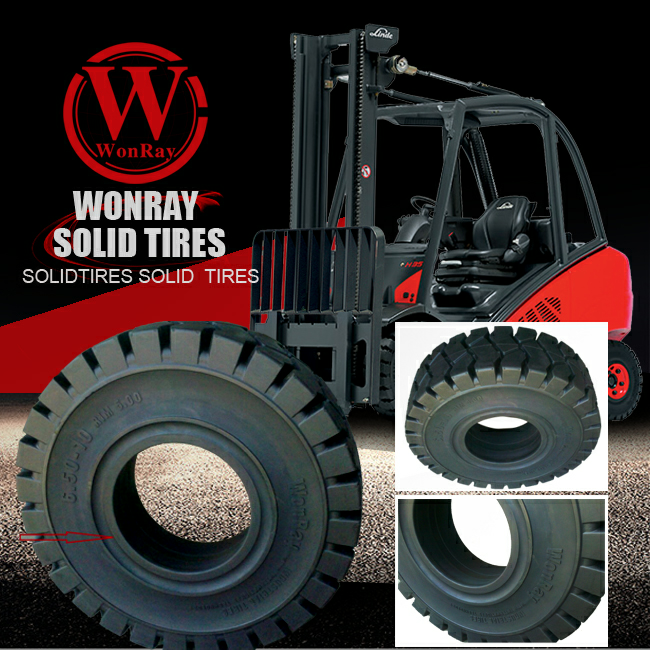
Which Wheel Specifications Matter for Quieter Operation?
Wheel selection should begin with the forklift’s design requirements rather than a general preference for softer or harder rubber. Hardness affects how the wheel deforms under pressure, influencing cushioning, rolling resistance, and contact behavior. The appropriate specification depends on the vehicle, its load distribution, and its operating environment. Dimensions are equally important. Wheel diameter, width, and mounting configuration must match the equipment’s requirements. An unsuitable size can affect clearance, operating geometry, and the relationship between the wheel and surrounding components. These mismatches may create additional problems without reducing noise.
Mounting compatibility also deserves attention. A correctly matched wheel assembly supports consistent rotation, while loose connections or unsuitable components can contribute to vibration and abnormal sounds. When a forklift becomes noisier immediately after a wheel replacement, installation and compatibility should be checked before blaming the rubber compound.
When evaluating Forklift Rubber Wheels, consider these factors together:
- Vehicle compatibility: Confirm dimensions, mounting arrangements, load requirements, and operating limits.
- Application conditions: Assess floor surfaces, operating routes, indoor temperatures, and exposure to contaminants.
- Performance balance: Evaluate noise, traction, rolling resistance, stability, and durability together.
The quietest option is not necessarily the most suitable. A wheel that reduces noise but compromises traction or stability may introduce more serious operational concerns. Wheel specifications should support the forklift’s intended use while addressing the actual source of noise.
What Else Can Help Reduce Indoor Forklift Noise?
Wheel selection works best alongside appropriate maintenance and operating practices. Even well-matched Forklift Rubber Wheels may produce abnormal noise if bearings are damaged, mounting components are loose, or the vehicle is operated over neglected flooring.
Routine inspections should include wheel condition, bearings, mounting hardware, and other rotating components. Grinding, clicking, or repeated knocking may indicate a mechanical issue that requires attention. These sounds should not automatically be attributed to the wheel material. Driving practices also influence noise. Excessive speed over uneven surfaces, abrupt direction changes, and unnecessary impacts can increase sound levels. Keeping travel routes clear and using suitable operating speeds can reduce avoidable noise without requiring immediate wheel replacement.
Comparing forklifts under similar operating conditions can provide further clues. If one vehicle is noticeably louder than others using the same route, its wheel assembly or mechanical systems may need closer inspection. If several vehicles produce similar noise in the same location, the floor or surrounding structure may be responsible.
Evaluating Forklift Rubber Wheels for Indoor Applications
Before replacing wheels, facilities should document the noise problem, identify the affected routes, and confirm the forklift’s operating requirements. This information helps establish whether wheel replacement is appropriate and which specifications deserve attention.
For industrial applications, Forklift Rubber Wheels should be evaluated according to the actual equipment and working environment. Reviewing mounting compatibility, wheel dimensions, floor conditions, and performance requirements can reduce the risk of choosing an unsuitable replacement. Where practical, a controlled comparison can help assess the result. Using the same route, similar loads, and comparable travel speeds before and after replacement makes it easier to determine whether the change has reduced rolling noise. Formal workplace noise assessments may require appropriate measuring equipment rather than subjective observation alone.
Conclusion
Reducing indoor forklift noise requires attention to wheel-to-floor contact, mechanical condition, flooring, and operating practices. Suitable Forklift Rubber Wheels may help reduce certain impact-related sounds, but their effectiveness depends on the application and the actual source of noise. Identifying the problem before replacing components, confirming wheel compatibility, and maintaining both the vehicle and floor provide a more reliable approach to noise control.
FAQ
1. Do rubber wheels make every forklift quieter?
No. Rubber wheels may reduce certain rolling and impact-related sounds, but they cannot eliminate noise from motors, hydraulic systems, brakes, bearings, or building structures. Results depend on operating conditions and the main noise source.
2. Are forklift rubber wheels suitable for every indoor floor?
Not necessarily. Forklift Rubber Wheels must match the forklift’s design, load requirements, traction needs, and floor conditions. Compatibility should be confirmed before replacement.
3. Why is a forklift still noisy after new wheels are installed?
Damaged flooring, worn bearings, loose mounting components, incorrect wheel dimensions, or installation problems may cause continued noise. The source should be identified before another replacement is considered.
4. How can operators evaluate whether wheel noise has decreased?
Compare the forklift before and after replacement under similar conditions, including the same route, comparable loads, and similar speeds. Record where noise occurs and use suitable sound measurement methods when a formal workplace assessment is required.
Post time: 24-10-2026