
A Solid Tire is a non-pneumatic tire built with dense rubber compounds for vehicles that work in factories, warehouses, ports, recycling yards, steel mills and heavy material handling sites. It is commonly used on forklifts, industrial trailers, skid steer loaders, wheel loaders, access platforms and other equipment that cannot afford frequent tire failure during daily operation. Because a solid tire does not rely on air pressure, it avoids many problems caused by punctures, sudden air loss and repeated pressure checks. For operators who care more about continuous operation than road-speed comfort, this tire type offers a more stable solution for demanding industrial movement.
Many tire decisions are made only when a vehicle is already stopped. A forklift begins to lean, a loader cannot move safely, or a trailer is pulled out of service because one wheel has failed. At that moment, the tire is no longer a small accessory; it has become a production issue. Choosing the right solid tire before these problems appear can help a site reduce emergency repairs and keep equipment available when loading, stacking, towing or transferring work must continue.
The hidden cost of one stopped industrial vehicle
When a pneumatic tire fails, the visible cost is the replacement tire. The less visible cost is the interruption around it. A forklift with a flat tire may block a warehouse aisle. A trailer with a damaged wheel may delay goods at a loading bay. A skid steer loader working near metal debris may stop in the middle of a cleaning or handling job. Workers then have to move goods manually, call maintenance staff, wait for parts and reorganize the work route. In a busy industrial site, that lost time can be more expensive than the tire itself.
A Solid Tire helps reduce this risk because it is designed to keep its shape without air. Sharp objects may still mark or cut the tread over time, but they do not create instant air loss. This is why solid tires are often preferred in workplaces with broken pallets, metal scraps, construction waste, uneven concrete, sharp stones or hot industrial surfaces. The tire is chosen not because it is impossible to wear, but because it is much less likely to cause sudden stoppage from a simple puncture.
What should a solid tire handle during a normal working day?
A good solid tire needs to do more than carry weight. It must support repeated start-stop movement, tight turning, side loading, braking, impact and long working hours. For forklift use, the tire must remain stable when the vehicle lifts heavy pallets or turns in narrow aisles. For trailers, it needs steady rolling and reliable rim fit. For loaders and outdoor industrial vehicles, the tire must resist cutting, chipping and deformation when the surface is rough or mixed with debris.
The working day of an industrial tire is repetitive. It may run over the same route hundreds of times and turn at the same corner under similar loads. If the compound, structure or tread does not match the site, wear and deformation can appear quickly. The correct Solid Tire should balance wear resistance, load support, rim stability and operating comfort according to the vehicle and the ground.
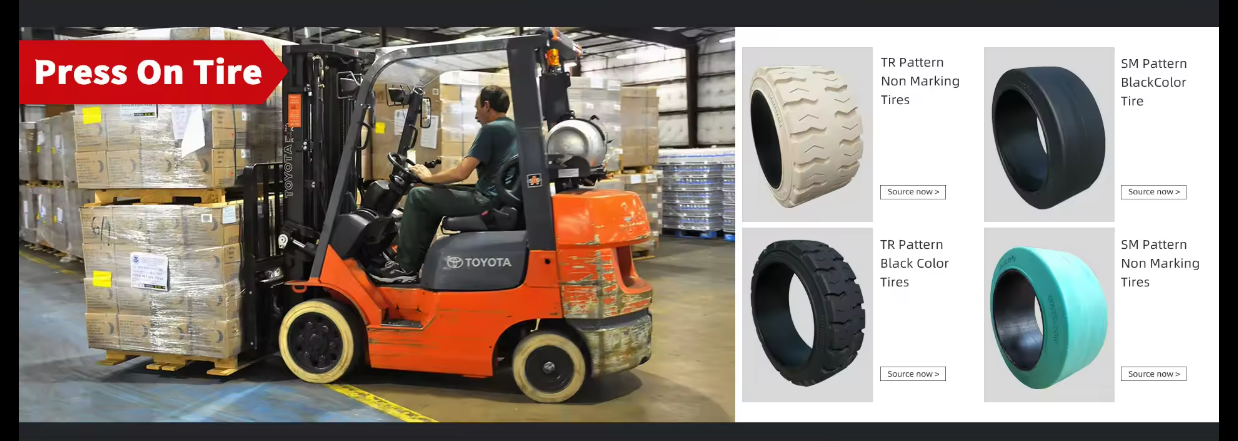
Different vehicles need different solid tire choices
A solid tire for a warehouse forklift is not the same as a solid tire for a wheel loader or a port trailer. Forklift tire solid applications often focus on stable lifting, smooth indoor travel and clean floor performance. Some forklifts require black rubber for durability, while indoor operations may prefer non-marking compounds to reduce floor marks. Industrial trailers may need solid wheels with dependable rolling performance under repeated towing. Skid steer and loader applications usually require stronger cut resistance and deeper tread support for rougher surfaces.
Before choosing a tire, the vehicle type should be confirmed together with current tire size, rim size, load weight, ground condition and working hours. A tire used on smooth concrete will not face the same stress as one used in a recycling yard or steel plant. A machine that works all day needs different attention from one used occasionally. Proper matching helps the solid tire deliver better service life instead of becoming only a size-based replacement.
How the structure supports durability and safety
The performance of a Solid Tire depends on rubber formulation, layered construction, tread design and rim matching. The outer tread area needs enough wear resistance and grip. The inner body must provide load-bearing strength and impact support. The base area must hold firmly to the rim so the tire remains stable during turning, braking and heavy loading. These structural details are especially important for vehicles that carry heavy goods or operate with frequent directional changes.
In many industrial applications, safety is related to predictability. A tire that keeps stable shape helps the vehicle move more consistently, while suitable traction reduces slipping on difficult surfaces. For companies managing several vehicles, this reliability also supports simpler maintenance planning.
Where WonRay solid tire applications fit
WonRay solid tire applications cover many industrial vehicles, including forklift solid tires, skid steer solid tires, wheel loader solid tires, trailer tires, port vehicle tires, steel mill tires, scissor lift wheels, boom lift wheels, mold-on tires and related rims. These products are used in environments where puncture resistance, stable load support and reduced maintenance are important. The suitable option should be selected according to equipment type and site conditions.
For a buyer, the practical question is not only whether to use a Solid Tire, but which tire structure, size and compound fits the equipment. A warehouse may care most about clean floors and steady forklift movement. A port may focus on long shifts and high load capacity. A waste handling site may prioritize puncture resistance and rough-ground durability. Matching these needs before purchase helps the tire support real operation rather than simply meeting a basic size requirement.
FAQ
Q1: What is a Solid Tire used for?
A Solid Tire is used for forklifts, trailers, skid steer loaders, wheel loaders, industrial vehicles, access platforms and other equipment that requires puncture-resistant and low-maintenance tire performance.
Q2: Is a solid tire better than a pneumatic tire?
A solid tire is usually better for low-speed, heavy-load and puncture-prone industrial environments. Pneumatic tires may offer more cushioning in some outdoor conditions, but they are more vulnerable to punctures and air leakage.
Q3: How do I choose the correct Solid Tire size?
The correct size depends on the existing tire marking, rim size, vehicle model, load weight and application. It is also important to confirm the working surface and operating frequency before selection.
Q4: Can solid tires be used indoors?
Yes. Solid tires are widely used indoors on forklifts and warehouse vehicles. For clean floors, non-marking solid tires may be selected to reduce black marks.
Post time: 08-07-2026