
A milling machine tire works in one of the most punishing construction environments. Road milling equipment moves slowly, carries concentrated loads, turns repeatedly, and operates around broken asphalt, sharp aggregate, metal fragments, and hot surfaces. The tire is therefore not a simple rolling component. It directly affects machine stability, cutting consistency, transport speed, and whether the crew can complete a section of road without an avoidable interruption.
The Tire Works at the Same Pace as the Cutting Drum
Unlike a general construction vehicle that spends much of its time travelling, a milling machine performs most of its work at low speed while the cutting drum applies continuous resistance. That operating pattern places repeated torque on the drive wheels. The tire must transfer force without excessive slip, but it must also absorb vibration generated by the drum and uneven pavement.
If the tire compound is too soft, heat and tread wear may increase quickly. If it is too hard, the wheel can lose useful cushioning and transmit more shock into the machine. A suitable milling machine tire balances traction, deformation control, and wear resistance so that the machine can maintain a steady feed rate.
Four Operating Signals That Reveal Tire Suitability
- Stable forward movement: the machine advances smoothly instead of surging when the drum meets harder pavement.
- Controlled steering: the tire maintains contact during repeated low-speed turns around manholes, edges, and lane transitions.
- Predictable temperature: the tire does not build excessive heat during long shifts or repeated repositioning.
- Even wear: the tread surface wears progressively rather than tearing in isolated areas.
These signals are often more useful than judging the tire only by its external appearance. A tire can look acceptable while internal heat, bonding stress, or uneven loading is already reducing its service life.
Why Solid Construction Matters on a Milling Site
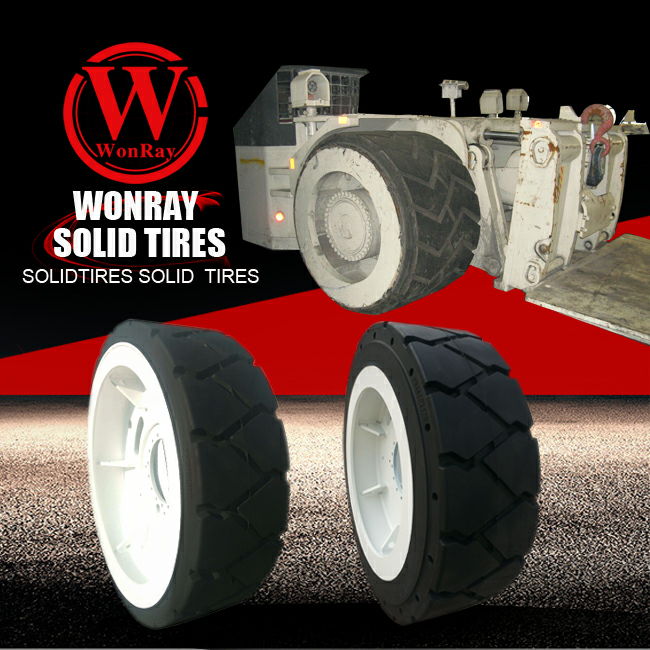
Pneumatic tires can provide cushioning, but they remain exposed to punctures and pressure variation. Milling sites contain cut steel, sharp stone, loose bolts, and fractured asphalt. A solid rubber construction removes air pressure from the operating equation. There is no puncture-related deflation, no daily pressure adjustment, and no sudden loss of support during a production pass.
For crews working under traffic-control windows, this predictability is especially valuable. The financial impact of a tire problem is rarely limited to the tire itself. It can include idle operators, delayed trucks, extended road closure time, and disruption to the paving schedule that follows.
Match the Tire to the Machine, Not Just the Diameter
Correct selection starts with the complete operating condition. Tire size is essential, but it is not sufficient. The machine model, wheel position, axle load, drive configuration, travelling distance, average shift length, surface temperature, and frequency of sharp turns all influence the required design.
- Confirm the exact tire dimensions and rim specification.
- Identify whether the wheel is driven, steering, supporting, or a combination of these functions.
- Record the actual working load rather than relying only on the machine’s empty weight.
- Consider the percentage of time spent milling, travelling, waiting, and turning.
- Check whether the route includes ramps, broken pavement, hot asphalt, or abrasive aggregate.
Tread Design Should Follow the Work Route
A deep aggressive pattern is not automatically the best choice. On a milling machine, the correct tread must provide traction while maintaining enough rubber mass to resist chunking. Machines working mainly on dry asphalt may use a different pattern from equipment that regularly encounters loose millings, wet pavement, or compacted base material.
The tread shoulder also deserves attention. Frequent steering at low speed can place high lateral stress on the outer edges. A reinforced shoulder and stable footprint help reduce irregular wear during repeated lane changes and tight manoeuvres.
Heat Is a Load-Management Issue
Solid tires do not fail only because the rubber touches a hot road. Heat is generated internally as the tire repeatedly deforms under load. Overloading, excessive travel speed, long continuous operation, and an unsuitable compound can all increase internal temperature. For this reason, a milling machine tire should be evaluated as part of the machine’s duty cycle.
Where shifts are long, planned cooling intervals, correct speed limits, and realistic load control can extend tire life. The goal is not simply to choose the hardest available rubber. The goal is to manage heat without sacrificing grip and vibration absorption.
A Better Replacement Plan Uses Position-Based Inspection
Fleet managers should inspect each wheel position separately. Drive tires may show torque-related wear, steering tires may show shoulder wear, and supporting wheels may reveal overload or alignment issues. Recording wear by position helps distinguish a tire problem from a machine or route problem.
Replacement should be planned before the tire reaches a condition that affects ride height or machine balance. On equipment with multiple solid tires, large diameter differences can change load distribution. Replacing tires as matched sets on the same axle or functional group can help maintain stable performance.
Conclusion
The best milling machine tire is not defined by one feature. It is the tire that fits the machine, survives the actual route, controls heat, supports traction, and wears predictably across the working cycle. When selection is based on load, position, surface, and duty cycle, the tire becomes part of production planning rather than an emergency repair item.
FAQ
1. Are solid tires suitable for road milling machines?
Yes. Solid tires are well suited to milling environments where puncture risks, concentrated loads, and predictable uptime are important. The specification must still match the machine and wheel position.
2. Why does a milling machine tire overheat?
Common causes include excessive load, long continuous travel, high speed, repeated deformation, and a compound that does not match the duty cycle.
3. Should all milling machine tires be replaced at the same time?
Not always, but tires on the same axle or functional group should have compatible diameters and wear levels to avoid uneven load distribution.
4. What information is needed to select a replacement tire?
Provide the machine model, tire size, rim details, wheel position, actual load, operating surface, shift length, and typical travel speed.
Post time: 21-07-2026