
Forklift Pneumatic Tire Conversion is most useful when a forklift repeatedly loses working time to punctures, pressure loss or damaged tubes on an industrial route. The conversion is not simply a matter of replacing an air-filled tire with the hardest available alternative. A pneumatic tire contributes cushioning, tire height and contact behavior to the truck, so changing to an airless construction can also change ride, rolling resistance, heat generation and the way impacts reach the chassis.
A good Forklift Pneumatic Tire Conversion therefore begins with one practical question: what problem is the current pneumatic setup actually causing? If the main problem is repeated flats from nails, wire or pallet debris, an airless solid-pneumatic format can remove the pressure-loss failure mode. If the main complaint is harsh ride on broken ground, insufficient flotation or excessive vibration, conversion may not solve the problem and can make it more noticeable.
Use the Existing Tire History to Decide Whether Conversion Is Justified
The strongest reason to change tire construction is a repeated failure pattern. One isolated puncture is different from a forklift that loses a tire every few weeks because the route contains unavoidable metal fragments. Maintenance records are more useful than assumptions because they show whether the cost is coming from punctures, pressure checks, sidewall damage, wear, heat or wheel problems.
• Frequent punctures or tube failures point toward an airless alternative.
• Repeated underinflation suggests pressure control is not working reliably.
• Sidewall impacts on rough ground may indicate a route or driving problem rather than an inflation problem.
• Fast tread wear without pressure loss may require a different compound or tread instead of a conversion.
• Excessive vibration on the current pneumatic setup should be understood before moving to a firmer tire.
The Conversion Changes More Than the Risk of a Flat
| What changes | Pneumatic setup | Airless solid-pneumatic setup |
| Load support | Air pressure and casing share the load | Rubber structure carries the load |
| Puncture outcome | Penetration can cause pressure loss | Penetration does not create ordinary deflation |
| Ride over joints and stones | Air volume provides more compliance | Response is generally firmer |
| Pressure checks | Required | Not required |
| Heat control | Affected by pressure and casing flex | Depends strongly on rubber deformation, load and duty |
| Tire height over time | Can change with pressure | More dimensionally consistent, but wears with use |
These differences explain why Forklift Pneumatic Tire Conversion should be evaluated as a change to the running system rather than a simple maintenance shortcut. The truck still has to steer, brake and carry load correctly after the change.
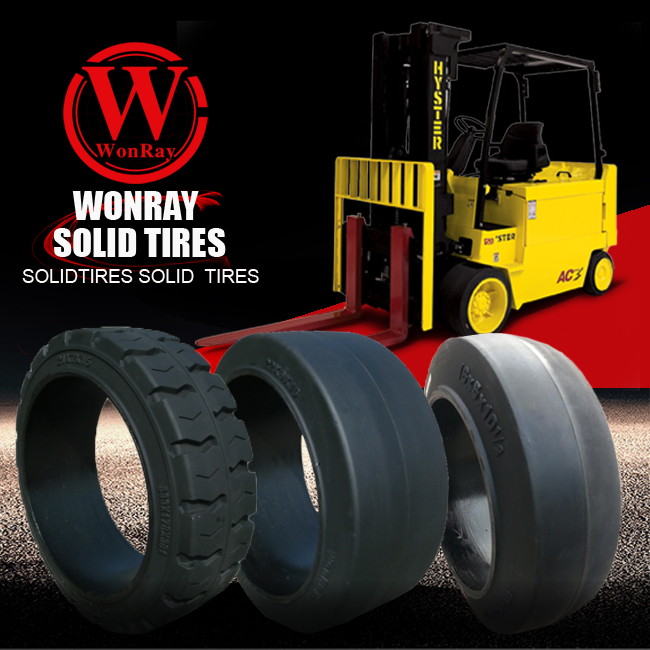
Solid-Pneumatic Format Is Usually the Closest Airless Alternative
For forklifts originally using pneumatic-profile tires, a solid-pneumatic tire is often the most practical airless direction when the machine and rim are compatible. It keeps a similar external form while replacing the air chamber with solid rubber. This can be useful in warehouses with broken pallets, recycling areas, building-material yards, ports and mixed industrial routes where punctures are difficult to eliminate.
The conversion still requires dimensional confirmation. Nominal size is not enough if actual outside diameter, section width, rim seating or available clearance differs. The effect of the heavier tire should also be considered during installation and service.
There Are Situations Where Keeping Pneumatic Tires Is the Better Decision
Forklift Pneumatic Tire Conversion should not be treated as an automatic upgrade. Pneumatic tires remain useful when terrain cushioning and flotation are more important than puncture resistance. Deep loose gravel, soft ground, severe ruts and long rough travel can favor the compliance of an air-filled tire, provided punctures are manageable.
A conversion also deserves caution when the forklift travels continuously for long distances or at the upper end of its intended speed. Solid rubber generates internal heat through repeated deformation. A truck that moves short distances in a scrap yard has a different thermal cycle from a truck that travels continuously between distant buildings.
A Small Trial Can Reveal More Than a Specification Sheet
When several similar forklifts are in service, one controlled trial can be more informative than changing the whole fleet at once. The trial should use a representative truck and normal route, then compare the previous pneumatic setup with the new airless setup under the same workload.
• Record puncture-related stops before the change.
• Compare operator vibration on the roughest normal section.
• Check steering effort and traction on ramps or wet zones.
• Measure tread temperature after the longest normal operating period.
• Track wear at the center and shoulders over a fixed number of hours.
• Confirm that ground clearance and wheel-to-chassis clearance remain acceptable.
The goal is not to prove that one construction is universally better. The goal is to verify whether the converted truck loses fewer hours to tire problems without creating unacceptable ride, heat or wear.
Do Not Use Conversion to Hide a Mechanical or Route Problem
A solid tire can remove ordinary puncture deflation, but it cannot correct overloaded axles, dragging brakes, poor alignment, damaged rims or sharp debris that should be removed from the route. If a converted tire immediately develops shoulder chunking, abnormal heat or one-sided wear, the operating cause should be investigated instead of assuming that a harder tire is needed.
The same applies to mixed tires on one axle. Large differences in construction or rolling diameter can affect load sharing and steering. Forklift Pneumatic Tire Conversion should therefore be planned by axle and machine, not one wheel at a time without comparison.
A Conversion Decision Should End With a Clear Operating Reason
Forklift Pneumatic Tire Conversion is most successful when the reason for changing is specific: repeated penetration damage, unreliable pressure maintenance, or a need for more predictable tire dimensions on a compatible industrial route. If those problems are not present, staying with pneumatic tires may be the more suitable choice.
WonRay can support airless forklift tire matching when the current tire size, rim, forklift model, wheel position and normal route are known. The most useful information is the current failure history, because it shows whether the change is likely to solve the real problem.
Frequently Asked Questions
1. Can every pneumatic forklift tire be converted to solid?
No. The forklift, rim, dimensions, load and available clearance must be compatible with the solid-pneumatic option.
2. Will conversion make the forklift ride harder?
Usually the response is firmer because there is no compressed-air chamber. The actual difference depends on tire construction, load and surface.
3. Does a solid tire completely eliminate tire maintenance?
No. It removes inflation checks and ordinary puncture deflation, but wear, heat, cuts, chunking and rim condition still require inspection.
4. What is the best sign that conversion is worthwhile?
A repeated, documented pressure-loss or puncture problem on a route where ride and heat remain acceptable after conversion is a strong case.
Post time: 26-08-2026