
Understanding Forklift Tyre Types is more useful than simply knowing the tire size printed on the sidewall. Two forklifts can work in the same warehouse and still require completely different tire constructions because their rims, chassis height, operating surfaces and working patterns are different. A tire that works well on a standard counterbalance forklift may not fit an electric forklift designed around a low-profile press-on wheel, even if both machines perform similar material-handling tasks.
The main distinction is not simply between “solid” and “air-filled.” Forklift tires can use different mounting systems, rubber constructions and tread designs. Non-marking compounds add another layer because they can be produced in more than one structural tire type. Understanding these differences helps avoid treating every forklift wheel as the same product.
The Main Forklift Tyre Types Are Defined by Construction
For practical industrial applications, forklift tires are commonly divided into several structural groups. The most relevant include pneumatic tires, solid pneumatic or resilient tires, and press-on band or cushion tires. Non-marking tires are better understood as a material option that can be applied to some of these categories rather than a completely separate wheel structure.
The table below shows the basic differences:
| Forklift Tyre Type | Main Structure | Typical Characteristic | Common Application Direction |
|---|---|---|---|
| Pneumatic Tire | Rubber tire with compressed air | More cushioning | Mixed or rougher surfaces |
| Solid Pneumatic / Resilient Tire | Solid rubber with pneumatic-style outside dimensions | No air pressure, strong load support | Warehouses, factories, industrial yards |
| Press-On Band / Cushion Tire | Rubber bonded to a steel band | Compact outside diameter and rigid construction | Indoor electric forklifts, confined spaces |
| Non-Marking Tire | Special rubber compound applied to solid or press-on tire | Reduces black floor marks | Clean warehouses, food, pharmaceutical, electronics |
This classification matters because each tire interacts with the forklift differently. Rim design, vehicle ground clearance and wheel mounting method must correspond to the tire structure rather than just the nominal size.
Solid Pneumatic Tires Keep the Familiar Pneumatic Tire Format
Solid pneumatic tires, also called resilient solid tires, use outside dimensions similar to pneumatic industrial tires but replace the air chamber with a solid rubber construction. This allows compatible products to use standard pneumatic-style rims without depending on inflation pressure.
The product is normally built from several rubber zones rather than one uniform block. A wear-resistant tread forms the outer working surface, while a more resilient center layer provides some cushioning. A stronger base compound and steel reinforcement help maintain the tire-to-rim connection. WonRay’s forklift solid tire page describes this three-compound construction and states that its solid pneumatic products are designed to fit standard pneumatic-style rims.
This structure is useful when equipment needs the basic dimensions of a conventional industrial tire but works in an environment where punctures and pressure maintenance are undesirable. Because there is no air chamber, normal penetration does not create the same immediate flat-tire failure as it would with a pneumatic design.
However, solid pneumatic tires are not simply “pneumatic tires without air.” Their deformation, heat generation and ride characteristics are different, so load, speed and duty cycle still need to match the product specification.
Press-On Band Tires Use a Completely Different Wheel System
Press-on band tires, also called cushion tires or press-on tires, should not be confused with solid pneumatic tires. Instead of mounting onto a conventional rim, the rubber is bonded to a steel band, and the band is pressed onto a compatible wheel center using an interference fit.
This gives the tire a compact construction. Press-on tires generally sit lower than solid pneumatic tires and are widely associated with electric forklifts and indoor applications where low chassis height and tight operating space are useful. The steel band forms part of the mounting system, which means the dimensions of the band and wheel center are critical.
The low-profile construction can be particularly practical in warehouses with smooth floors and narrow aisles. However, the same feature means a press-on band tire cannot simply replace a solid pneumatic tire by matching outside diameter alone. The forklift must already be designed for the appropriate wheel system.
This is one of the most important distinctions among Forklift Tyre Types: two tires can both be solid rubber, yet require completely different wheels.
Pneumatic Tires Still Have a Clear Role
Pneumatic forklift tires use compressed air to support the vehicle. The air chamber gives the tire greater ability to deform around uneven surfaces, which can improve cushioning where the forklift travels over rough pavement, yard surfaces or mixed indoor and outdoor routes.
The trade-off is that tire pressure becomes part of maintenance. Pressure that is too low or too high can affect tire shape, contact with the ground and wear. Sharp debris can also create puncture-related downtime.
For forklifts operating mainly on clean, well-maintained indoor floors, these advantages may be less important than the puncture resistance of a solid design. On rougher outdoor surfaces, however, pneumatic construction can still be appropriate when the machine was designed around that tire type and cushioning is a key operating requirement.
Therefore, the correct comparison is not “solid tires are always better than pneumatic tires.” The better question is which tire construction matches the machine and the surface.
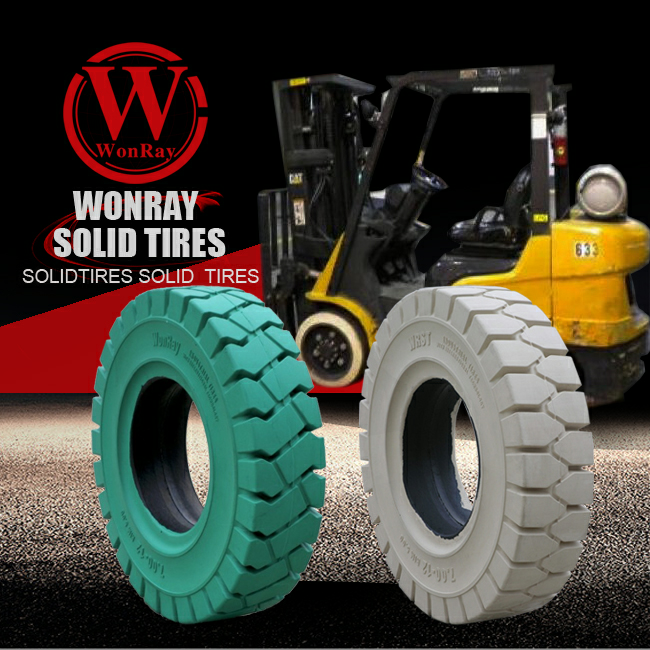
Non-Marking Tires Describe the Rubber, Not the Complete Structure
Non-marking forklift tires are often discussed as another Forklift Tyre Type, but this can cause confusion. “Non-marking” primarily describes the rubber compound and its effect on the floor rather than a unique mounting system.
Non-marking products are designed for environments where black tire marks or contamination are undesirable. They are commonly grey, white or other light colors and can be used in clean industrial environments such as pharmaceutical, food, textile, electronics and aviation-related facilities. WonRay’s product information also states that non-marking versions can be produced across solid tire sizes and that press-on band tires can also be produced in non-marking compounds.
This means a forklift could use a non-marking solid pneumatic tire or a non-marking press-on band tire.
So when someone specifies “non-marking forklift tire,” one more question remains: which structural tire type does the forklift use?
The Forklift Wheel Often Decides the Tire Type Before the Floor Does
Working conditions are important, but the existing wheel system creates the first technical boundary. A forklift designed for press-on band tires cannot normally be converted to a pneumatic-style solid tire simply because the operator prefers another tread. Likewise, a standard rim for a solid pneumatic tire is not the same as the wheel center used for a press-on band tire.
Before comparing compounds or tread patterns, the wheel should therefore be identified. Useful information includes the current tire size, rim or wheel dimensions, machine model and wheel position.
Once the mounting system is clear, operating conditions can be used to choose the most appropriate variation within that category.
For example, a solid pneumatic tire may be available with different tread designs or rubber compounds, while a press-on tire may be smooth or treaded depending on the intended surface.
Floor Conditions Change the Best Choice Within Each Category
Forklift Tyre Types provide the basic product structure, but the working floor determines many of the finer details.
Smooth warehouse floors favor predictable rolling and controlled tread deformation. Deep, aggressive tread is often unnecessary if the forklift never leaves a clean indoor environment. In contrast, mixed surfaces, loading docks and outdoor industrial areas may benefit from stronger tread engagement.
Clean facilities may require non-marking rubber, while harsh industrial environments may place greater emphasis on wear resistance or deeper tread designs.
This is why tire selection should not stop at the statement “the forklift uses solid tires.” The type of solid tire, tread, compound and wheel position still need to be defined.
How to Choose Between Forklift Tyre Types
A simple selection process can begin with four questions:
- What wheel system is currently installed?
Identify whether the forklift uses pneumatic-style rims, press-on wheel centers or another configuration. - Where does the forklift operate?
Smooth indoor floors, outdoor pavement and mixed surfaces create different requirements. - Is floor marking a concern?
If cleanliness matters, a non-marking compound may be required, but the structural tire type still needs to match the wheel. - What are the real load and operating conditions?
Forklift capacity, wheel position, travel speed, working hours and turning frequency all affect the final specification.
Following this order prevents the common mistake of choosing a tire based on one attractive feature before confirming whether it physically belongs on the machine.
WonRay Forklift Tire Solutions
For forklift applications, WonRay’s product range covers several of these tire categories rather than relying on a single solid tire design. The company’s forklift solid pneumatic products use a three-compound construction with a wear-resistant tread, resilient center compound and reinforced base, while its press-on band range uses rubber bonded to a steel band for compatible low-profile wheel systems. Non-marking versions are also available for clean-floor applications.
When matching Forklift Tyre Types, the useful starting information includes the forklift model, existing tire marking, rim or wheel size, installation position and operating environment. If the existing product is unclear, photos of both the tire and wheel can help distinguish a press-on system from a pneumatic-style solid tire arrangement.
This makes the solution more specific than simply recommending “a solid forklift tire.” The goal is to match the correct construction first, then select the appropriate tread, compound and size for the actual application.
Conclusion
Understanding Forklift Tyre Types starts with construction rather than appearance. Pneumatic tires use air pressure, solid pneumatic tires use resilient solid rubber on compatible pneumatic-style rims, and press-on band tires use rubber bonded to a steel band fitted onto a dedicated wheel center. Non-marking rubber can then be applied where clean floors are required.
No single type is correct for every forklift. The existing wheel system, operating surface, load, working space and cleanliness requirements all influence the final choice. By identifying the structural tire category first, the rest of the selection process becomes much more accurate and easier to manage.
FAQ
What are the main Forklift Tyre Types?
The main structural types include pneumatic tires, solid pneumatic or resilient tires, and press-on band or cushion tires. Non-marking is usually a compound option available within some solid tire categories.
Can solid pneumatic tires replace pneumatic forklift tires?
Compatible solid pneumatic tires can use standard pneumatic-style rims, but size, load rating and machine requirements still need to be confirmed before replacement.
Are press-on tires the same as solid pneumatic tires?
No. Press-on tires use rubber bonded to a steel band and are pressed onto a compatible wheel center. Solid pneumatic tires use a different construction and rim system.
Are non-marking forklift tires only available as one type?
No. Non-marking compounds can be used in different solid tire constructions, including solid pneumatic and press-on band products.
Post time: 12-09-2026