
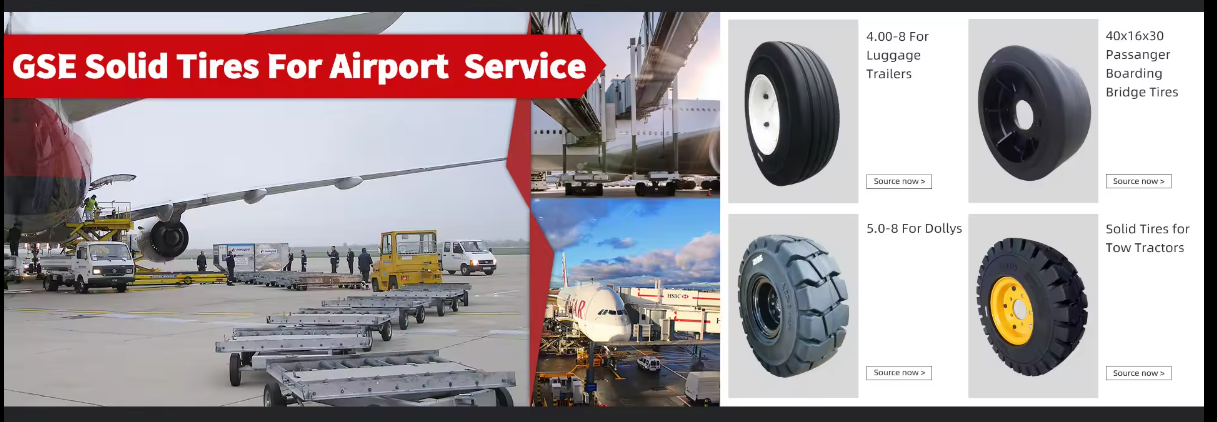
A Boarding Bridge Tire supports the travelling section of a passenger boarding bridge as it moves toward or away from an aircraft. It carries the bridge load, transfers drive force, assists steering, and helps the bridge maintain controlled movement during docking and retraction.
Unlike a vehicle tire that mainly covers distance, a boarding bridge tire is part of a positioning system. Its most important task is not high-speed travel. It must help a large structure move slowly, stop accurately, and remain stable while passengers enter or leave the aircraft.
This difference explains why boarding bridge tire selection should focus on precision, load distribution, wheel compatibility, and repeated low-speed movement.
The Tire’s Job Begins Before the Bridge Moves
When the boarding bridge is parked, its tires may remain under load for extended periods. The bridge may not move again until the next aircraft arrives.
Long static loading can contribute to temporary deformation or flat-spot behavior, particularly when the tire construction is not suited to the bridge weight. When movement begins, the operator may feel vibration or an uneven rolling sensation.
The effect may reduce after the tire completes several rotations, but repeated deformation can still increase wear and place additional stress on the wheel assembly.
A suitable Boarding Bridge Tire should therefore be evaluated for both moving and stationary load conditions.
Start-Up Movement Reveals Hidden Problems
The first few seconds of bridge movement often reveal whether the wheel system is operating correctly.
A tire that slips, hesitates, or turns unevenly may cause the bridge to start with a sudden movement. This can make precise control more difficult and increase stress on the drive mechanism.
Possible causes include surface contamination, worn tread, mismatched tire diameters, uneven load distribution, wheel misalignment, or inconsistent tire hardness between paired wheels.
Replacing only one tire in a multi-wheel assembly may create a difference in rolling radius. Even a relatively small difference can cause one wheel to carry more load or rotate at a different effective speed.
For that reason, maintenance teams should inspect the entire wheel group rather than treating each tire as an isolated component.
Controlled Approach Is More Important Than Maximum Traction
As the bridge approaches an aircraft, the operator needs smooth and predictable movement. Excessive wheel slip can reduce control, but aggressive grip is not the only requirement.
The tire should provide stable traction without creating abrupt steering response. It should roll consistently across the apron surface, including painted lines, joints, wet areas, and slight surface changes.
A tread pattern suited to the airport environment can help, but rubber compound and contact pressure are equally important. A tire with excessive hardness may provide long wear under some conditions but transfer more vibration. A softer tire may improve cushioning but deform more heavily under the bridge load.
The objective is controlled movement, not simply maximum hardness or maximum tread depth.
Docking Accuracy Depends on the Whole Wheel System
The final docking phase involves small adjustments. The bridge may move only a short distance, but the movement must be accurate.
At this stage, tire condition, wheel alignment, drive-system response, and surface grip work together. If one tire has a smaller effective diameter because of wear, it may rotate differently from the other tire. If a tire is damaged or partially separated from its base, the bridge may not track smoothly.
Operators may compensate through additional steering corrections, but this can increase tire scrub and accelerate wear.
A recurring need for correction should therefore be investigated rather than treated as normal operating behavior.
What Different Wear Patterns Can Tell Maintenance Teams
Boarding bridge tires often provide visible evidence of mechanical or operational problems.
Wear across the centre of the tire may indicate concentrated loading or an unsuitable contact profile. Heavy shoulder wear may be linked to turning scrub or misalignment. One-sided wear often suggests that the wheel is not travelling squarely.
Repeated flat areas may be associated with long stationary periods, braking behavior, or uneven loading. Surface tearing can occur when the tire turns under high static load or when debris becomes trapped around the wheel.
Cracks near the tire base require careful attention because they may be connected to rim fit, installation damage, aging, or repeated side loading.
The wear pattern should be photographed and recorded before the old tire is removed. This provides useful information for the next replacement decision.
Tire and Rim Compatibility Cannot Be Assumed
Two Boarding Bridge Tire products with the same nominal outside diameter may not have identical base dimensions or installation requirements.
The rim width, mounting structure, hub position, keyway arrangement, bolt pattern, and available clearance may affect compatibility. Some boarding bridge wheels may be supplied as complete tire-and-wheel assemblies, while others require the tire to be installed on an existing rim.
Before ordering, the buyer should confirm whether a loose tire, pressed assembly, or complete wheel is needed.
Measurements should be taken from technical drawings where possible. Measuring an old, heavily worn tire alone can be misleading because its diameter and profile may have changed during service.
Airport Environment Changes the Selection
Boarding bridges may operate in very different climates. Some are exposed to strong sunlight and high apron temperatures. Others work in rain, snow, coastal air, or severe winter conditions.
Temperature affects rubber behavior. High temperatures can increase heat aging and deformation, while low temperatures may reduce flexibility. Moisture, de-icing chemicals, oil, and surface contaminants can also affect traction and material life.
The selected tire should match the operating environment rather than only the bridge model. The same boarding bridge design may require different tire characteristics when installed at airports with very different climates.
Replacement Should Be Planned Before Failure
Waiting until a Boarding Bridge Tire becomes unusable can create unnecessary gate downtime. Boarding bridges are fixed infrastructure, and an unexpected tire failure may affect passenger handling and aircraft turnaround arrangements.
Maintenance teams should establish inspection limits for tread condition, cracking, deformation, base damage, and diameter difference between paired tires. Replacement stock should be ordered before the existing tire reaches the end of acceptable service.
Where tires are used in pairs or groups, replacing matched positions together may help maintain consistent diameter and load distribution. The decision should be based on wheel-system design and measured tire condition.
A Useful Pre-Order Checklist
A technically useful request should include more than the words “Boarding Bridge Tire.” The following information helps identify the correct product:
- · Boarding bridge brand and model
- · Existing tire markings
- · Outside diameter and width
- · Rim or hub dimensions
- · Number of tires in the travelling assembly
- · Drive wheel or support wheel position
- · Maximum load or wheel load
- · Indoor or outdoor operation
- · Temperature and weather conditions
- · Photographs and technical drawings
- · Whether a complete wheel assembly is required
When the original tire has failed, the buyer should also describe how it failed. This may reveal that an alignment, load, or installation problem needs to be corrected at the same time.
Stable Gate Operation Starts at Ground Level
Boarding bridge tires are easy to overlook because they move slowly and remain below the main passenger structure. However, their condition directly affects bridge travel, alignment, docking control, vibration, and maintenance availability.
A reliable selection process begins with the actual bridge structure and operating environment. Correct dimensions are essential, but they are only one part of the decision. Load, wheel position, tire hardness, traction, climate, rim fit, and replacement matching all need to be considered together.
Frequently Asked Questions
How often should a Boarding Bridge Tire be inspected?
Inspection frequency should follow the airport’s maintenance plan and bridge usage. Tires should also be checked immediately when vibration, slipping, uneven travel, or visible damage appears.
Should paired boarding bridge tires be replaced together?
It may be advisable when diameter difference or uneven wear could affect load distribution and travel accuracy. The wheel-system design should be reviewed before deciding.
Can the old tire be measured to order a replacement?
It can provide useful information, but technical drawings and rim dimensions are more reliable because a worn tire may no longer represent its original size.
Why does a boarding bridge move unevenly after tire replacement?
Possible causes include mismatched tire diameters, incorrect installation, rim problems, wheel misalignment, uneven load distribution, or differences between old and new tires.
Post time: 28-07-2026