
The 33×12-20 Tire is a good example of a problem that appears frequently in industrial tire replacement: the same nominal size can describe products that are not built the same way. In WonRay’s published data, the 33×12-20 size appears in both a conventional skid-steer solid tire configuration and an integrated mold-on or cured-on configuration.
Both versions share similar outside dimensions, but their wheel architecture, product weight and rated operating conditions are different. This means the size name alone cannot tell you which product the machine actually uses.
33×12-20 and 12×16.5 Belong to the Same Size Family
WonRay lists the skid-steer product as 12×16.5 (33×12-20). This dual designation is common in industrial equipment because the same general tire family may be described using different sizing conventions.
For maintenance records, that creates a practical risk. One document may list 12×16.5 while the old tire is marked 33×12-20. If a technician assumes these are unrelated sizes, the replacement search can become unnecessarily difficult.
The safest approach is to compare the complete dimensions and wheel structure. In WonRay’s standard skid-steer solid tire table, the product uses an 8.00-20 rim, R708 tread, approximately 840 mm outside diameter and 275 mm section width.
Standard Solid Tire and Mold-On Wheel Are Not the Same Product
The conventional skid-steer configuration is a separate solid tire that is installed on a compatible rim. The wheel and tire remain separate components in the product system.
The mold-on version uses a different architecture. Rubber is cured directly onto the metal wheel center during production, creating an integrated wheel in which the rubber and center are not normally separated during service.
This difference changes replacement planning. With the separate tire, an existing suitable rim may be reused. With the mold-on product, the complete integrated wheel is replaced as one assembly.
A machine that uses one system should not be converted to the other simply because the outside dimensions look similar. The hub and mounting interface still have to match the equipment.
The Published Dimensions Are Similar, but the Weight Is Not
WonRay’s standard skid-steer 33×12-20 configuration is published at approximately 840 mm outside diameter, 275 mm width and about 91 kg net tire weight. The mold-on FB12x16.5 (33×12-20) configuration uses the same published outside diameter and width but weighs about 136 kg as an integrated wheel.
That difference makes sense because the mold-on product includes the wheel center as part of the complete assembly and uses a different rubber-to-metal structure.
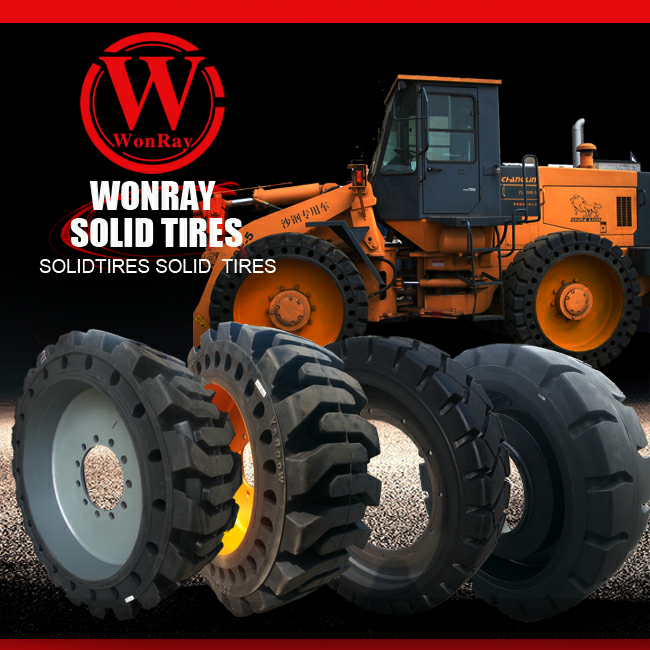
Both Versions Use Holes, but the Purpose Is Structural
WonRay identifies both configurations as using holes in the solid-tire structure. These are engineered openings rather than puncture damage. The holes modify the way the rubber deforms and can add a degree of compliance to an otherwise solid wheel.
This is particularly relevant on skid-steer and construction equipment because the machine can work on broken concrete, compacted soil, gravel and other irregular surfaces. A fully solid section provides puncture resistance, while engineered openings can influence shock response and rubber movement.
The hole design should be treated as part of the original product engineering. Drilling holes into a standard solid tire after production would not create an equivalent product because the rubber structure, load path and heat behavior were not designed around those openings.
R708 Tread Connects the Two Configurations
Both the standard skid-steer tire and the mold-on 33×12-20 configuration are listed with R708 tread. This can make the products look even more similar from the outside.
However, identical tread does not mean identical construction. Tread is only the ground-contact layer. The mounting system, internal rubber volume, wheel center, weight and load condition still differ.
Load Values Must Be Compared With Speed Conditions
WonRay lists the standard 12×16.5 (33×12-20) skid-steer tire with a maximum load of approximately 4050 kg for other industrial vehicles at 25 km/h. The mold-on FB12x16.5 version is listed at approximately 4500 kg at 16 km/h.
It would be misleading to compare 4050 and 4500 directly and conclude that one product is simply stronger. The two values correspond to different product architectures and different specified speeds.
The useful comparison is that each configuration has its own load-speed condition. When replacing a tire, the machine’s actual travel speed and duty cycle should be matched to the relevant table rather than using whichever number is larger.
Which Version Is on the Machine Now?
The easiest way to tell the difference is to inspect the wheel. If the rubber tire is a separate component mounted on a conventional rim, the machine uses the standard tire-and-rim system. If the rubber is permanently cured onto the metal center and the assembly is replaced as one piece, it is a mold-on or cured-on wheel.
Photographs of both sides make this distinction clear in most cases. The machine model, hub arrangement and old part number also help.
Do not rely only on the 33×12-20 marking. The same marking can lead to two very different replacement components.
How Working Conditions Affect the Better Choice
If the original machine was designed around a conventional tire-and-rim assembly, retaining that system can make rim reuse possible when the wheel remains in good condition. It also allows the tire and wheel to be inspected separately.
An integrated mold-on wheel can be useful where the application benefits from a factory-controlled rubber-to-center relationship and complete-wheel replacement. WonRay describes mold-on construction as useful for stability and heat-release performance in several industrial applications.
The correct choice is normally the architecture already designed into the machine. Changing wheel system requires more than comparing nominal tire dimensions.
WonRay 33×12-20 Tire Options
WonRay publishes both architectures for the 33×12-20 Tire size family. The skid-steer solid tire version is listed as 12×16.5 (33×12-20), using an 8.00-20 rim, R708 tread, about 840 mm outside diameter, 275 mm width, approximately 91 kg net tire weight and a listed load of 4050 kg at 25 km/h for other industrial vehicles.
The mold-on FB12x16.5 (33×12-20) version is also listed with R708 tread, 840 mm outside diameter and 275 mm width, but the integrated wheel weighs about 136 kg and is listed at 4500 kg maximum load at 16 km/h.
For matching, provide the machine brand and model, photographs of both sides of the existing wheel, the current tire marking, rim or hub information, operating speed, load and working surface. This allows WonRay to determine which 33×12-20 architecture corresponds to the equipment rather than selecting from nominal size alone.
Conclusion
A 33×12-20 Tire can represent two products that look similar but function as different wheel systems. One is a separate skid-steer solid tire mounted on a rim; the other is an integrated mold-on wheel in which the rubber and metal center form one assembly.
Because the outside dimensions and tread can be similar, replacement identification must include the wheel structure. Product weight, mounting method, load-speed condition and service strategy all change with the architecture. The most reliable replacement starts by asking not only “What size is the tire?” but also “How is this wheel built?”
FAQ
Is 33×12-20 the same size family as 12×16.5?
WonRay lists 12×16.5 and 33×12-20 together for this skid-steer size family.
What are the published outside dimensions?
Both published WonRay configurations are approximately 840 mm outside diameter and 275 mm section width.
Why does the mold-on version weigh more?
It is an integrated wheel that includes the metal center as part of the product, while the standard configuration is a separate tire.
Post time: 18-09-2026