
The 22x9x16 Tire is a useful example of why industrial press-on tires should be identified by more than outside diameter. The three-number size describes a compact tire that is built around a steel-band mounting system: approximately 22 inches outside diameter, 9 inches width and 16 inches inside band diameter. Each dimension matters because the tire is pressed onto a matching wheel center rather than installed on a conventional pneumatic-style rim.
That construction makes the 22x9x16 Tire very different from a solid pneumatic forklift tire even though both products contain solid rubber. To replace it correctly, the band, wheel center, tread type, load and operating speed all need to be understood together.
What the Three Numbers Mean
Press-on tire sizes are commonly written as outside diameter x width x inside diameter. For a 22x9x16 tire, the nominal geometry is therefore 22 inches by 9 inches by 16 inches. In metric terms, WonRay’s published specification lists approximately 559 x 229 x 406 mm.
The third dimension is particularly important because it relates to the steel band and wheel-center fit. A tire can have the correct outside diameter and width but still be unusable if the band diameter does not match the wheel.
This is why the full three-part size should always be recorded from the old tire. Shortening the description to “22-inch forklift tire” removes the information most closely connected to the mounting system.
Why Press-On Tires Use a Steel Band
A press-on tire is made by bonding the rubber tread to a steel band. During installation, that band is pressed onto a wheel center using an interference fit. The steel band becomes the mechanical connection between the rubber tire and the wheel.
This design creates a compact, low-profile wheel package. It is widely used on indoor industrial equipment where floor conditions are relatively good and chassis height needs to remain controlled. Because there is no air chamber, the tire does not require inflation-pressure maintenance.
However, the design also means the band-to-wheel fit has to be precise. An incorrect wheel-center diameter can prevent installation or create insufficient retention. Press-on tires should therefore be matched using both tire and wheel information.
Smooth and Treaded Versions Serve Different Floors
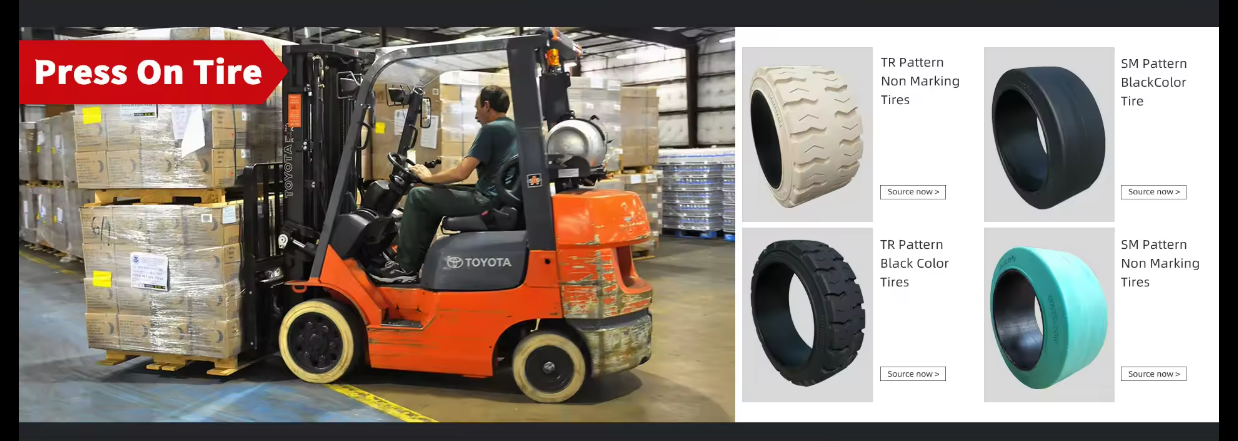
WonRay lists the 22x9x16 size with SM/TR pattern options. SM refers to a smooth configuration, while TR refers to a treaded option. This choice should follow the operating surface.
A smooth tire can provide a large, stable contact area on clean indoor concrete. It avoids unnecessary tread-block movement and is often suitable where traction demand is moderate. A treaded version adds edges and channels that may be useful when the floor is dusty, damp or includes mixed surfaces.
The decision should be based on the route rather than on the assumption that more tread always means better performance. Deep or flexible tread blocks can also generate additional movement during tight steering on hard floors.
Why Load Tables Separate Driving and Steering Positions
Press-on forklift tires can be used on different wheel positions, and the mechanical duty changes between them. The drive wheel transmits traction and braking torque, while the steering wheel experiences high turning angles and lateral scrub.
WonRay’s published 22x9x16 data therefore provide separate maximum loads for driving and steering positions at 10 km/h and 16 km/h, plus a value for other industrial vehicles at 16 km/h. This is a useful reminder that a single maximum-load number is not enough.
For replacement matching, the wheel position must be known. Using the drive-position value to justify a steering application can give an incorrect result because the table intentionally treats those conditions differently.
Speed Changes the Allowable Load
Solid rubber generates heat as it repeatedly deforms under load. Higher speed increases the number of deformation cycles per unit time, so allowable load generally decreases as the specified speed increases.
For the WonRay 22x9x16 configuration, the listed drive-position load changes from 3745 kg at 10 km/h to 3315 kg at 16 km/h. The steering value changes from 3335 kg to 3010 kg over the same speed increase, while the listed value for other industrial vehicles at 16 km/h is 2880 kg.
These are product-specific published values rather than universal numbers for every 22x9x16 tire, but they clearly demonstrate why load and speed must be read together.
Wheel-Center Condition Can Cause Installation Problems
Because the tire is pressed onto a wheel center, the condition of that center matters. Corrosion, wear, deformation or previous machining can change the interference fit. A wheel that has been reused many times should be inspected before another tire is pressed on.
Measure the center where possible and look for polished movement marks, cracking, burrs or uneven surfaces. If the tire has previously slipped on the wheel, simply pressing on another identical tire may not solve the underlying problem.
For fleets with multiple similar forklifts, mark wheel centers carefully during maintenance because visually similar centers may use different dimensions.
Pressing Technique Is Part of the Replacement Process
A press-on tire should be installed with appropriate tire-press equipment. Force needs to be applied evenly so the steel band moves straight onto the wheel center. Misalignment during pressing can damage the tire, band or wheel.
Lubrication or installation aids should follow the product and service procedure rather than improvised methods that could affect retention. The wheel should also be supported correctly so that pressing force does not distort the center.
If the operation does not have suitable equipment, a pre-pressed tire-and-wheel assembly can simplify maintenance after the wheel specification has been confirmed.
WonRay 22x9x16 Tire Specification
WonRay publishes the 22x9x16 Tire in its press-on forklift tire range. The listed metric size is 559 x 229 x 406 mm, with smooth or treaded pattern options. Net weight is approximately 43 kg.
The published maximum loads are 3745 kg driving and 3335 kg steering at 10 km/h, 3315 kg driving and 3010 kg steering at 16 km/h, and 2880 kg for other industrial vehicles at 16 km/h. These values apply to WonRay’s listed configuration and should be matched to the real machine and wheel position.
For a replacement inquiry, provide the full 22x9x16 marking, forklift model, wheel-center dimensions, driving or steering position, normal load, maximum speed and preferred smooth or treaded surface. Photos of the current tire and wheel center are also useful when the original specification is uncertain.
Conclusion
A 22x9x16 Tire is defined by a three-part size because all three dimensions are important to the press-on wheel system. The outside diameter controls overall wheel size, the width affects the contact footprint and clearance, and the 16-inch band diameter determines the connection to the wheel center.
Correct replacement also requires the right pattern, wheel position, speed and load. When those details are checked together, the 22x9x16 tire becomes a precise industrial component rather than just another solid forklift tire.
FAQ
What does 22x9x16 mean?
It describes approximately 22 inches outside diameter, 9 inches width and 16 inches inside band diameter for the press-on tire.
What are the metric dimensions in WonRay’s published table?
WonRay lists approximately 559 x 229 x 406 mm for its 22x9x16 configuration.
Is the 22x9x16 available smooth or treaded?
WonRay lists both SM and TR pattern options for this size.
Post time: 17-09-2026