
A 16x5x12 Wheel is a much more specific search term than “scissor lift tire,” but even this exact size does not identify a single universal replacement wheel.A 16x5x12 Wheel is a highly specific scissor-lift wheel size, but the size alone still does not identify a universal replacement. Wheels in this size class can differ in brake arrangement, tread pattern, hub or center structure, mounting interface, and product weight even when their outside dimensions are similar.
This makes the 16x5x12 Wheel a good example of why aerial-work-platform wheels should be identified as complete components rather than by outer size alone.
What Does 16x5x12 Describe?
The 16x5x12 designation gives useful size information, but it does not fully describe the wheel center.
The 16x5x12 designation gives useful size information, but it does not fully describe the wheel center. A finished wheel in this class is typically around 406 mm in outside diameter and 125 mm in width, which provides a useful starting point for checking the replacement envelope.
For a scissor lift, this matters because wheel diameter influences chassis height and ground clearance, while width affects both floor contact and physical clearance around the drive or steering system.However, two wheels with the same 406 x 125 mm external dimensions can still have different internal structures.
With Brake and Without Brake Are Different Products
With-brake and without-brake versions should be treated as different wheel products. They may share similar external rubber dimensions while using different center hardware and different product weights.
That is an important clue.The brake-related hardware or center configuration is part of the complete wheel. A non-brake wheel should not be treated as interchangeable with a brake-equipped version just because the rubber dimensions are identical.
Before replacement, the machine position should therefore be identified.If the existing wheel is part of a drive-and-brake assembly, the replacement needs the corresponding center design. If it is a free or different-position wheel, the requirements may change.
R706 and R707 Tread Options
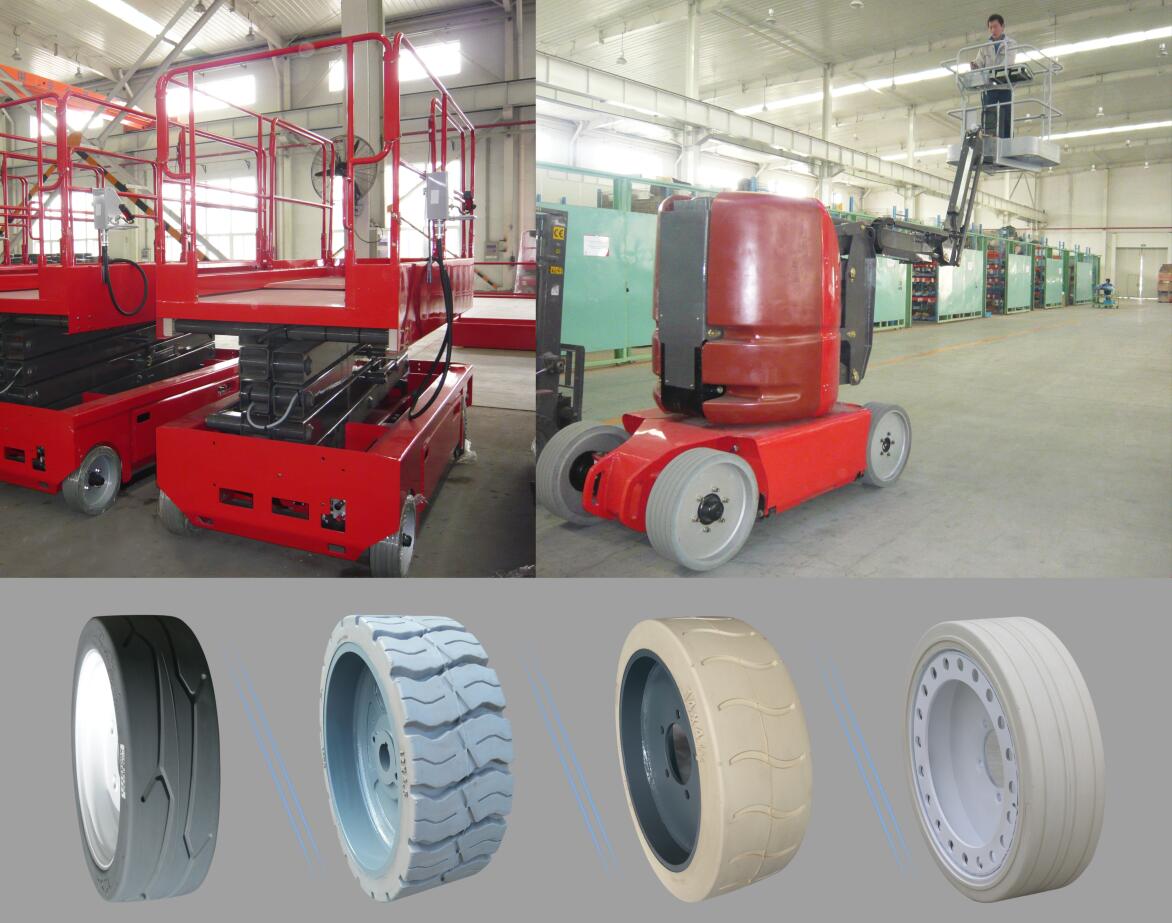
Two common tread options in this size class are R706 and R707-style patterns. Tread is therefore another variable that should be checked rather than assumed from the 16x5x12 size alone.This means tread is another variable within the same size.A replacement inquiry that provides only “16x5x12” still leaves the tread specification open.
For many scissor-lift applications, the machine works on relatively hard surfaces where predictable low-speed movement is more important than aggressive off-road traction. The tread therefore needs to match how the platform is actually used.
If the original wheel has a specific pattern, reproducing that pattern can help maintain consistent rolling and steering characteristics across the wheel set.
Why Maximum Load Is Published at 10 km/h
Load data for scissor-lift wheels are normally tied to a low-speed operating condition. For this size class, published industrial ratings may be specified around 10 km/h, which reflects the low-speed positioning duty of aerial work equipment rather than road-vehicle operation.
The speed condition matters because industrial tire load capability should not be separated from operating speed.Scissor lifts normally move at low speed, particularly during precise positioning. The wheel is designed around that kind of duty rather than highway-style travel.
This is why a published load rating should not be transferred to another machine with a completely different speed and operating cycle merely because the wheel appears to fit.
The Same External Size Can Hide Different Centers
The same external 406 x 125 mm class can also hide different center configurations. A wheel may use similar rubber dimensions yet have a different brake interface, hub, mounting geometry, or product weight, so external measurements are only part of the identification process.
This reinforces the main point: external dimensions do not fully identify an access-platform wheel.The hub, center, brake interface, mounting holes, drive connection, or other internal geometry may differ.
A technician who measures only the outside rubber can still order the wrong product.Both sides of the wheel should therefore be photographed and measured.
Why Scissor Lift Wheels Often Use Solid Construction
Scissor lifts spend much of their working life moving short distances, stopping, and supporting the machine in a fixed position.This makes low-speed reliability more important than high-speed ride characteristics.
Solid wheels avoid inflation-pressure maintenance and remove ordinary puncture-related flats. For indoor machines, non-marking materials may also be selected where floor appearance matters.
Non-marking solid wheels are widely used on scissor lift platforms because many machines work indoors on finished floors. The same wheel family can also be supplied in different tread and center configurations for major aerial-platform brands, so model and mounting details remain important.
Should All Four Wheels Be Replaced Together?
Not always, but the remaining wheels should be inspected.A new 16x5x12 Wheel has its full outside diameter, while heavily worn wheels may be smaller. Large differences can alter chassis support height or produce different rolling behavior from one corner of the machine to another.
Tread pattern and wheel-center type should also remain consistent with the machine’s design.
If only one wheel has failed because of mechanical damage, a single replacement may be appropriate. If several wheels are near the end of their usable rubber, replacing the set or axle pair may provide more consistent geometry.
The decision should be based on actual wheel condition rather than a fixed rule.
How to Identify a 16x5x12 Wheel
Start with the machine manufacturer, model, and serial information if available.Then confirm the marking on the original wheel. Measure the outside diameter and width to verify that they correspond to the 406 x 125 mm class.
Next, identify whether the wheel position uses a brake.Photograph the inner and outer center structure, including mounting holes, drive interfaces, and any visible part numbers.
Finally, compare tread pattern and overall wear condition with the remaining wheels.This process is more reliable than ordering from “16x5x12” alone.
WonRay 16x5x12 Wheel Solutions
WonRay supplies 16x5x12 scissor-lift wheels in brake and non-brake configurations, with R706/R707 tread options and related 406 x 125 mm wheel variants. These configurations are designed around low-speed aerial-platform applications rather than general vehicle use.
To select the correct version, provide the lift brand and model, installation position, brake requirement, original wheel photos, center dimensions, and any visible part number. WonRay can then match the complete wheel instead of relying only on the outside size.
Where indoor floor protection is important, non-marking options can also be considered together with tread and center design. The goal is to reproduce the machine’s original mounting and rolling characteristics while providing a wheel suited to the actual work environment.
The practical solution is to match not only external size but the complete center structure and wheel position. Once machine model, brake requirement, tread, mounting interface, and existing-wheel dimensions are known, the 16x5x12 specification becomes much more precise.
Conclusion
A 16x5x12 Wheel is not a universal 16-inch solid wheel.The same 16x5x12 size class can include brake and non-brake variants, multiple tread options, and different center configurations. The external size alone is not enough to identify the correct replacement.
For scissor-lift replacement, the wheel should therefore be identified from both the rubber and the center.Outside diameter, width, brake type, tread, machine model, mounting interface, and wheel position all matter. Matching these details is what turns a size number into the correct replacement component.
FAQ
1、What is the outside diameter of a 16x5x12 Wheel?
Products in this class are commonly around 406 mm outside diameter and roughly 125 mm wide, but the complete specification should still be confirmed.
2、Are brake and non-brake 16x5x12 Wheels the same?
No. Similar external dimensions do not make the center hardware or brake interface interchangeable.
3、What tread patterns are available?
More than one tread can be used in this size class, so the original pattern or application requirement should be confirmed before replacement.
4、Is wheel size enough to order a replacement?
No. Machine model, brake requirement, hub or center structure, mounting dimensions, wheel position, and tread should also be confirmed.
Post time: 11-09-2026