
A 14.00-24 Tire is a large industrial solid tire that requires planning for rim fit, machine clearance, tread selection, load, transport, lifting, and installation. Learn how to manage replacement correctly.
This Size Is a Handling Project as Well as a Tire Choice
A 14.00-24 Tire belongs to a much larger class of industrial solid tires than typical forklift sizes. Published industrial solid-tire data for this size can show complete tires weighing close to 390 kg. At that mass, replacement is no longer a simple workshop task where one technician rolls a tire to the machine and fits it by hand. Storage, lifting, transport inside the facility, wheel inspection, and installation equipment become part of the maintenance plan.
This changes how the tire should be selected. A wrong specification does not only create a fitment problem; it can create a costly handling problem because the tire may require a forklift, crane, tire handler, or press just to move and install it. The right replacement process therefore begins before the old tire is removed.
Confirm the Machine and Rim Before the Tire Arrives
The nominal 14.00-24 size does not tell you the complete wheel configuration. This size may be supplied on a 10-inch rim in more than one tread configuration, while other manufacturers or machines may use different approved wheel details. The existing rim should be identified and inspected before a replacement is ordered.
Check rim markings, width, condition, mounting pattern, center hole, offset, and any multi-piece components. Large solid tires can place high loads into the wheel, so cracks, deformation, severe corrosion, and damaged seating surfaces should not be ignored. If the existing wheel has a repair history, document it. Reusing a questionable rim simply to avoid replacing the wheel can turn a tire change into a repeated maintenance event.
Two Published 14.00-24 Configurations Show Why Details Matter
Published examples show that two 14.00-24 solid tires can have very similar nominal size while differing slightly in finished geometry and tread. One configuration may be around 1340 mm in outside diameter and 328 mm in section width, while another can be closer to 1330 mm by 330 mm. This illustrates why the nominal size should be checked together with the complete product specification.
The numbers are close, but the tread and finished geometry are not identical. A ten-millimeter difference in outside diameter may be small relative to the overall size, yet replacement planning should still consider axle pairing and machine clearance. More importantly, R701 and R708 represent different tread designs, so the operating surface should guide the choice rather than assuming that any 14.00-24 tire behaves the same.
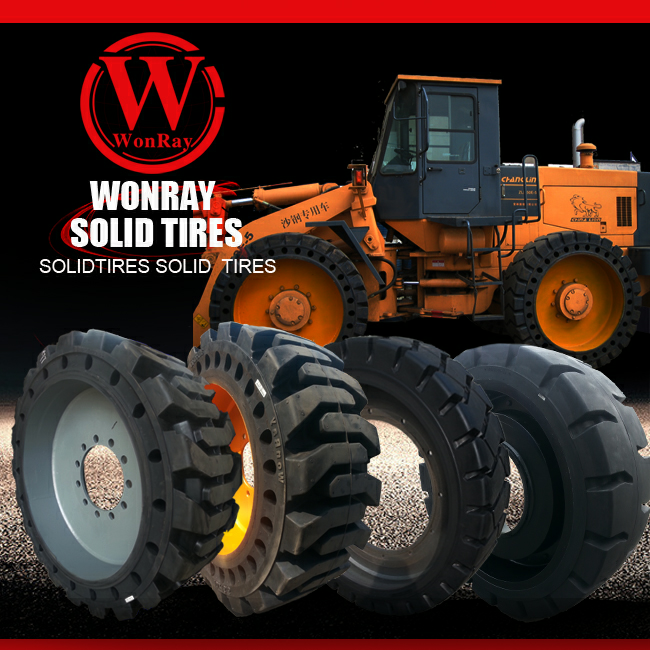
Tread Selection Should Follow the Jobsite
Large industrial tires may work on compacted soil, broken concrete, quarry surfaces, scrap yards, construction sites, or mixed paved and unpaved routes. The tire needs enough tread stability to carry load while also providing traction on the actual surface. A pattern optimized for one environment may wear differently in another.
Inspect the current tread before replacement. Rounded blocks can indicate heavy turning on hard ground. Cuts and missing chunks point toward debris or sharp edges. Polished high spots can show repeated sliding. Deep remaining tread with structural damage may indicate impact or heat rather than simple wear. The old tire is therefore a record of the jobsite, and its damage should influence the new tread decision.
Large Solid Tires Need Heat and Duty-Cycle Discipline
A large mass of solid rubber repeatedly compresses as the tire rolls. Under high load and continuous travel, internal deformation creates heat. Speed, load, ambient temperature, route length, and rest periods all influence the thermal cycle. A tire can be within its static size requirement yet still be poorly matched to a long continuous operating schedule.
This is why published load data must be read with the stated speed condition. Any published load value is tied to a stated speed and application condition. It should not be treated as an unlimited capacity independent of speed, machine layout, or duty cycle. Maintenance planning should record real travel speed and hours rather than relying only on machine rated capacity.
Replacement Logistics Should Be Designed Before Shutdown
Because a 14.00-24 solid tire is extremely heavy, the maintenance team should plan the lifting path from storage to the machine. Confirm floor capacity, lifting-device capacity, available clearance, attachment points, and whether the wheel can be removed as an assembly. The work area should be prepared before the equipment is taken out of production.
If tire pressing is required, verify press capacity and tooling in advance. If a complete tire-and-wheel assembly is being installed, check bolt pattern, center bore, offset, and fastener condition before lifting the assembly into position. This planning reduces the chance that the machine remains out of service while the team searches for a suitable press, lifting fixture, or replacement wheel.
Pairing and Diameter Matter on Multi-Wheel Equipment
Large industrial vehicles often depend on balanced tire dimensions across an axle or wheel set. Installing one full-diameter new tire next to a heavily worn tire can change rolling radius and load sharing. The machine may lean slightly or place more load on the taller tire, depending on suspension and axle design.
Before replacing only one 14.00-24 Tire, measure or compare the other tires. If wear differences are large, maintenance planning may need to consider axle pairs or a scheduled staged replacement. The correct decision depends on the machine design, but the key point is that a large tire should not be evaluated in isolation from the rest of the wheel set.
WonRay 14.00-24 Tire Options
For matching, provide the equipment brand and model, existing tire and rim markings, wheel position, current tread pattern, maximum operating load, normal travel speed, route surface, daily working hours, and photos of the worn tire. For this size, it is also useful to confirm whether the facility needs tire-only supply or a wheel-assembly solution because installation logistics can be as important as the tire specification itself.
Conclusion
A 14.00-24 Tire is a heavy industrial component, not a routine small-tire replacement. The rim, tread, machine geometry, axle pairing, heat cycle, lifting method, and installation equipment all need to be planned.
The published size and load figures are useful only when connected to the real machine and duty cycle. Confirm fitment before delivery, study the old tire’s wear, and prepare the handling process before shutdown. That approach reduces both technical risk and avoidable downtime.
FAQ
How much does WonRay’s 14.00-24 solid tire weigh?
The published R701 and R708 versions are approximately 389 kg and 390 kg respectively.
What rim is listed for the WonRay 14.00-24?
The published table lists a 10-inch rim for both configurations.
Are the R701 and R708 versions the same size?
They share the same nominal size but have slightly different published outside diameter, section width, and tread design.
Why should replacement logistics be planned early?
At roughly 390 kg per tire, safe lifting, transport, pressing, and wheel handling require suitable equipment and workspace.
Post time: 24-09-2026