
A 12×4 Solid Tire is easy to underestimate because the number looks small beside the size of the machine it supports. On a compact scissor lift, however, the wheel sits at the point where every start, turn, brake, floor joint, and static load reaches the ground. The lift may travel only short distances, but it repeats those movements all day. That makes a compact solid wheel less of a simple spare part and more of a key part of how the machine feels and behaves at floor level.
This is especially relevant to indoor access equipment. Scissor lifts often work in warehouses, factories, exhibition halls, shopping areas, maintenance workshops, and finished buildings where the floor is smooth, the turning space is limited, and visible black tire marks may be unacceptable. In that setting, a solid, non-marking wheel can solve several problems at once: there is no inflation pressure to check, a nail cannot create a conventional flat, and the tread compound can be selected to reduce dark marking on finished floors. The value comes from combining those functions without making the wheel too soft, too hard, or dimensionally wrong for the machine.
Why 12×4 Is More Than a Size Label
Current scissor-lift wheel specifications list a 12×4 wheel in both brake and non-brake configurations. The published product data shows an outside diameter of about 310 mm, a section width of about 100 mm, an R707 pattern, and a maximum-load reference of 680 kg in the listed 10 km/h condition. Those numbers are useful, but they should not be treated as a universal fitment rule. The same nominal size can be built around different hubs, brake arrangements, bolt patterns, bearings, offsets, and wheel-center designs.
That is why the most important part of a 12×4 Solid Tire is often hidden inside the wheel. A replacement can have the right outside diameter and still sit incorrectly on the axle. A few millimeters in hub length or offset can change clearance around the brake or chassis. A different bore or bearing arrangement can make an otherwise suitable tire impossible to install. On compact access equipment, where the wheel is close to guards, brakes, and steering components, the complete geometry matters as much as the rubber.
The Real Work Happens During Short, Repeated Movements
A scissor lift does not drive like a road vehicle. It rolls from one work point to another, stops, raises the platform, waits under load, lowers, turns, and repeats. A wheel may make hundreds of low-speed direction changes without ever covering a large distance. That pattern concentrates stress in a way that a mileage figure does not explain.
During a tight turn, the tread is dragged sideways against the floor. During braking, load shifts and the contact patch changes. When the lift stays parked with the platform lowered, the same area of rubber carries static weight for an extended period. When the machine crosses an expansion joint or threshold, the solid wheel absorbs a short impact. None of these events is extreme by itself, but their repetition determines how the wheel wears.
A well-matched 12×4 Solid Tire should therefore feel uneventful in service. It should roll consistently, keep the machine at the intended ride height, respond predictably to steering, and avoid creating a new maintenance issue after the old wheel is replaced. That quiet consistency is more valuable than a dramatic claim about hardness or service life.
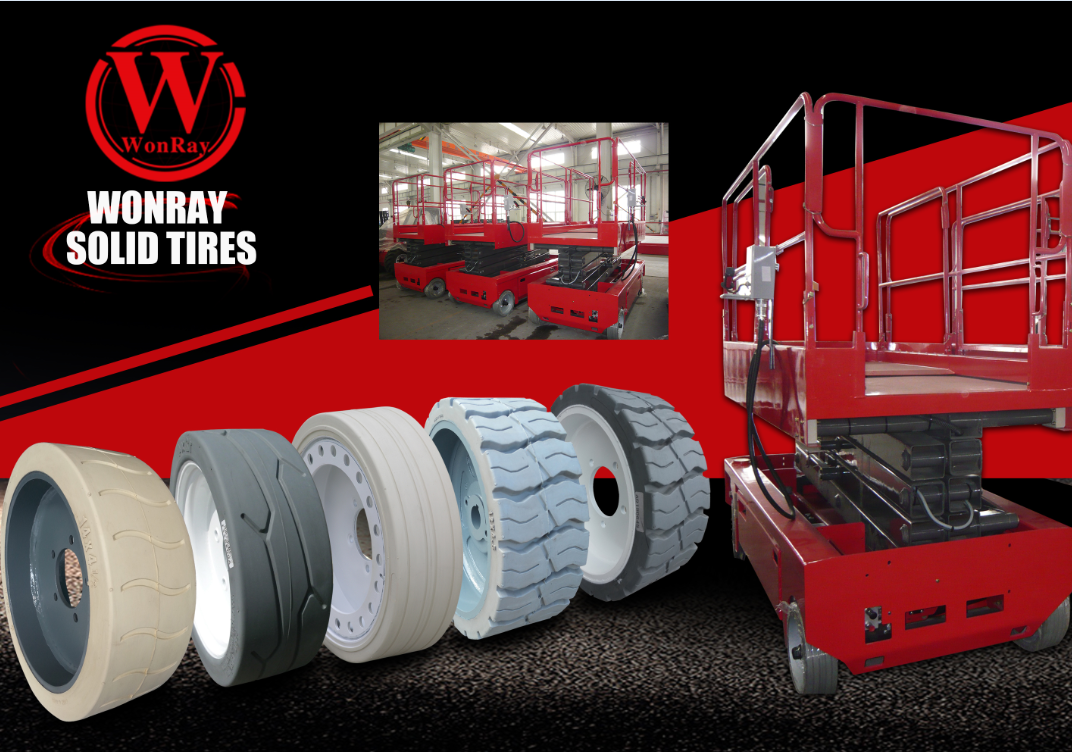
Non-Marking Performance Matters Most Where Turning Is Frequent
Dark floor marks are usually created where a tire experiences high friction: tight corners, braking points, loading positions, and areas where the machine pivots repeatedly. A compact scissor lift can create exactly this pattern because it often turns in restricted indoor spaces. Using a non-marking compound reduces visible dark transfer, but color alone does not define whether the wheel is suitable.
A non-marking wheel still has to carry the machine, resist chunking during steering, maintain grip on the actual floor, and tolerate the daily duty cycle. If the compound is too soft for the load, deformation and heat can increase. If it is too hard for the floor, vibration and sliding can become more noticeable. The useful product is not simply a white or light-colored wheel. It is a solid wheel whose compound, dimensions, load capability, and surface behavior work together.
Brake and Non-Brake Versions Change the Replacement Question
The presence of separate 12×4 brake and non-brake versions is a good reminder that size is only the first line of a replacement specification. On access equipment, the wheel can be part of a larger braking or drive arrangement. Two wheels can look nearly identical from the side and still use different centers, mounting details, or clearances.
What Wear Around a 12×4 Wheel Is Trying to Tell You
Small wheels often reveal problems quickly because they complete more revolutions over the same travel distance than a larger wheel. If one wheel develops shoulder wear while the opposite wheel remains even, the cause may be alignment, steering geometry, brake drag, unequal load, or repeated turning in one direction. If the tread surface becomes polished, the floor may be smooth or contaminated, or the wheel may be sliding during braking. If chunks break away near the edge, repeated lateral scrub, impact, or an unsuitable compound may be involved.
Reading the damage before changing the wheel prevents a common mistake: installing a new tire into the same mechanical problem. A new 12×4 Solid Tire cannot correct a dragging brake, damaged bearing, bent wheel center, overloaded axle, or misalignment. If those conditions remain, the replacement may reproduce the same wear pattern.
Indoor Use Does Not Mean the Route Is Easy
For this reason, the best 12×4 wheel is not selected by indoor use alone. The actual route should define the balance between non-marking performance, traction, resilience, wear resistance, and rolling effort. A lift that travels mainly on smooth dry concrete has a different requirement from one that repeatedly crosses thresholds or works near washdown areas.
The Product Should Support the Lift Without Becoming the Story
WonRay’s scissor-lift wheel range includes 12×4 solid wheel configurations as part of its broader AWP wheel offering. The useful way to approach this product is to start with the exact machine interface and daily route, then match the solid wheel around those conditions. The 12×4 marking gets the search started; the complete wheel geometry, load, compound, floor, and operating cycle determine whether the replacement is actually right.
Frequently Asked Questions
1. Where is a 12×4 Solid Tire commonly relevant?
It is relevant to compact industrial and access-equipment wheel applications where the original machine uses a compatible 12×4 solid wheel. WonRay lists 12×4 variants in its scissor-lift wheel range, but machine and hub compatibility still need to be confirmed.
2. Does every 12×4 solid tire fit the same scissor lift?
No. Nominal size does not define the hub, brake configuration, bearing, bore, offset, or mounting interface. The complete wheel specification must match the machine.
3. Why are non-marking 12×4 wheels useful indoors?
They help reduce visible dark rubber marks during turning and braking on finished floors while retaining a solid, puncture-free construction. Load, traction, wear, and wheel fit still need to match the application.
4. What should be checked when one 12×4 wheel wears faster than the others?
Check wheel alignment, brake drag, bearing condition, load distribution, steering pattern, floor condition, wheel dimensions, and whether the compound is suitable for the route before assuming the rubber alone is the cause.
Post time: 13-08-2026